How to choose the Right Air Purifier?
 admin
adminAir purifiers are expensive and a long term purchase. There are a number of factors that you must consider before deciding which air purifier to buy. Here is a list of things to consider in terms of importance
Clean Air delivery rate (CADR)
CADR is usually measured in Cubic meters per hour (M3/H) or Cubic feet per minute (CFM). The CADR determines how much the air purifier can clean in a given amount of time. This in turn determines the maximum room size where your air purifier would be effective. The CADR of most air purifiers varies from around 200 M3/H to 500 M3/H. The higher the CADR, the more expensive the air purifier would be. As a general rule of thumb if you know the CADR of an air purifier in M3/H, then just multiply it by 1.3 to get the maximum room size in square meters. For example, if the CADR of an air purifier is 230, then the max room size would be 1.3 X 230 = 300 Sq feet. (3 air changes per hour, which is what you need in Pakistan).
CADR of some well known brands is
- Xiaomi Smart Air Purifier 4 Pro + 500M3/H
- Zebsol Air purifier 450 M3/H
- GFC air purifier GF-400 400 M3/H
- Beurer LR 400 350 M3/H
- Royal fan air purifier 230 M3/H
Replacement filter cost and availability for 5 years
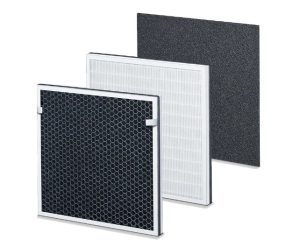
An air purifier is a consumer durable item like a fridge or an air conditioner. You are buying it for the next 5-7 years and not for one season. This means that you should be sure that replacement filters for your model and brand will be available throughout the year and for the next several years. The other factor is the cost of the replacement filter. A HEPA filter lasts around 1200 hours in Pakistani pollution. So that means that you'll have to purchase a filter every 4-5 months with 10 hours of usage per day. The cost of expensive filters will add up and make your purchase more expensive over the next 5 years. The quality of hepa filters matters as well, but for a layperson it is not possible to test the filter. Here is a list of brands where filters are easily available and their price
- Zebsol Air purifiers Rs 4000/-
- Philips 1000 series Rs 10000 to 25,000/-
- Xiaomi 4 Pro+ Rs 14,500/-
- Beurer LR200/300 Rs 10,000 to Rs 15,000/-
- Royal Fan air purifier Rs 7000/-
After-sales services and parts availability
Being an electronic item, there is a probability that something might go wrong with the air purifier. It could be a faulty sensor, blower and some other electronic issue. You should be sure that you'll get good after-sales services and cheap parts from the company. In this regard, local manufacturers are a much safer bet than the imported ones as parts would be easily available. Also ensure that the product has a warranty and that warranty claims are honored without any hassle.
In terms of best after-sales services, these brands are known to be extremely good.
- ZebSol Air purifiers
- Royal fans
- GFC air purifiers
- Super Asia air purifiers
- Cannon air purifiers
Initial purchase price
The price of an air purifier in Pakistan varies from Rs 25,000 for the cheapest models to around 1.5 lakhs for high-end brands. As mentioned earlier, mostly the price is determined by CADR of the air purifier. Here are some of the cheapest options available
- Certeza Rs 26,500/-
- Iforrest Rs 25,000/-
- Zebsol Rs 27,000/-
- Royal fan Rs 32,000/-
- GFC GF-270 Rs 36,000/-
- Noise level and power consumption
As per our experience, the noise level of all almost all purifiers is the same. It is a function of CADR. The higher the CADR, the higher would be noise level. Most people think that the noise comes from the fan or the motor of the fan. This is not true, the noise is generated when the fans move the air at high speed. The noise is from the air and not from the motor. The noise level for most air purifiers is from 25 db to 60 db depending on the speed and mode of operation. Just make sure that the air purifier has a night mode or whisper mode, which you can use at night time.
The power consumption of air purifiers is usually around 50-70 Watts. However, the air purifiers using BLDC motors consume a lot less power.
Here are the top purifiers with the lowest power consumption
- Zebsol air purifier 10 to 20 Watts
- Philips air purifier 56 Watts
- Xiaomi air purifier 65 Watts
- Royal air purifier 55 Watts
- GFC air purifier 22 Watts
- AQI indication
Most high-end air purifiers have a built-in AQI indication. In some models it shows the numeric value and in some cases, the air quality is indicated by color. Most sensors in the air purifiers are not laser based and hence not very accurate to start with. In addition to this, the customers should keep in mind that the built-in AQI sensor is located in the air purifier, which means that it only detects air quality around the air purifier and not in the room or some distance away from the air purifier. The air around the air purifier gets cleaned quickly but it does not mean that the entire room has the same level, so it is a bit misleading and gives a much better reading than the actual AQI of the room. It's like sensing the cold air coming out of the AC near its vents. So although the air is cold, but it does not mean that the entire room is cold as well. Due to this reason, at Zebsol, we sell a separate portable AQI meter which can be placed anywhere in the room to get a better idea of the AQI in the room.
So before deciding which air purifier to purchase, keep these factors in mind.
\ Get the latest news /